
October 18, 2026
How to Pack Fragile Items for Moving in New Orleans
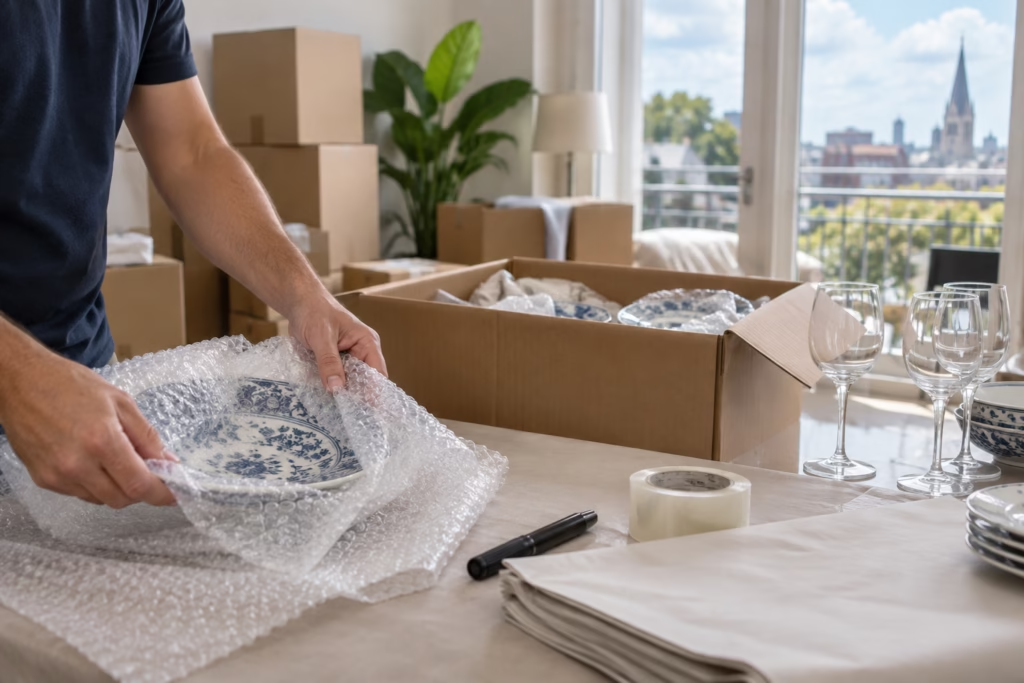
Quick answer: To pack fragile items for moving, wrap each piece individually, place it in a sturdy box with cushioning on every side, and fill gaps so nothing shifts. Keep heavier items at the bottom, separate delicate surfaces, and label each box with its contents, destination room, and “Fragile.” Use purpose-built cartons or professional packing help for large, unusually shaped, or especially valuable pieces.
What supplies do you need to pack fragile items?
Start with sturdy cardboard boxes, packing tape, clean packing paper, bubble cushioning, and a marker. Cardboard dividers are useful for glasses, while dish-pack cartons offer stronger walls for breakable kitchenware. Choose boxes you can lift comfortably rather than putting an entire collection of dishes into one large container.
Inspect reused boxes before packing. Avoid cartons with crushed corners, torn seams, water damage, or weakened bottoms. Tape the bottom along the center seam and across the edges, then add a cushioning layer. A box should support its contents without bulging or sagging when lifted.
Use clean packing paper against most everyday dishes and glassware; printed newspaper can transfer ink. Towels can provide extra padding around wrapped objects, but they should not leave hard surfaces touching. For artwork, antiques, or delicate finishes, check appropriate material guidance before wrapping because some surfaces can react to plastic or adhesives.
How should you wrap and arrange fragile items?
Set up a clear packing surface and sort objects by size, weight, and fragility. Examine each item for loose parts or existing cracks before handling it. Remove detachable lids, bases, and accessories when appropriate, and wrap them separately. Keep small components in a labeled bag beside the wrapped item without letting hardware press against it.
Wrap every piece individually, covering edges, corners, handles, and other projections. Add cushioning around vulnerable areas without forcing material into a tight space or putting pressure on a thin handle. Secure wrapping to itself rather than placing tape directly on the object.
Arrange the heaviest wrapped pieces first and keep lighter, more delicate pieces above them. Fill spaces along the box walls and between objects with packing paper or suitable cushioning. Nothing should touch the outer cardboard directly or be able to knock against another item.
Before sealing, gently check for movement without shaking the box. Add cushioning wherever contents can slide, and cover the top with another protective layer. The flaps should close flat without pressure. If they bow upward, repack into a larger box or divide the contents rather than forcing the carton shut.
How do you pack dishes, glasses, and stemware?
Wrap plates individually and place them vertically on their edges in a well-cushioned dish carton, rather than stacking them flat. Separate them with cushioning and keep them snug without compression. Nest bowls only when they fit comfortably, with each bowl wrapped and padding between the surfaces.
For drinking glasses, gently tuck packing paper inside and wrap the outside completely. Place wrapped glasses upright in individual cardboard cells when possible, adding cushioning so they cannot rattle. Do not nest unprotected glasses together; contact between rims and walls can cause chips or cracks.
Stemware needs protection around the bowl, stem, and base. Wrap the stem gently before cushioning the entire glass, taking care not to create a tight bundle that bends or stresses it. Use appropriately sized dividers and avoid placing heavier items above fragile rims.
Pack mugs with attention to their handles, and wrap teapot lids or serving-dish covers separately. Avoid filling a delicate serving bowl with heavy kitchen tools, even if there appears to be spare space. Grouping compatible items is safer than using every available gap.
How do you protect mirrors, artwork, lamps, and electronics?
Use a properly sized mirror or picture carton for framed glass and mirrors. Protect corners, cushion the frame, and prevent anything from pressing against the glass. Do not apply tape directly to artwork or delicate finishes. For valuable art or oversized mirrors, ask about appropriate packing methods and whether specialized handling is needed.
For lamps, remove the shade and bulb before wrapping the base. Pack the shade separately in a clean box with light cushioning that supports it without crushing its shape. Keep heavy objects out of that carton, and wrap bulbs separately with protection around the glass.
For televisions and other electronics, use the original fitted packaging if it remains sound. Otherwise, choose packaging designed for the device, especially for screens. Follow the manufacturer’s transport instructions, protect the screen from pressure, and label disconnected cables so setup is easier.
Unusually shaped objects require support around their main body, not just extra wrapping on protruding parts. A sculpture with thin extensions or a large glass tabletop may need more than a standard carton. Stop if you cannot support the piece without stressing it, and ask for packing guidance before moving it.
How should fragile boxes be labeled, loaded, and unpacked?
Label the top and sides with “Fragile,” the destination room, and a useful description such as “Kitchen: stemware.” Add orientation arrows where direction matters. Labels help communicate handling needs, but they do not replace sturdy packaging or proper cushioning.
Keep fragile cartons separate from heavy boxes while staging the move. During loading, place them where they will remain supported and cannot be crushed or slide into open space. Avoid putting them beneath furniture or dense cartons of books. Tell anyone handling them about pieces that need particular care.
For a New Orleans move, plan how to keep cartons dry between the doorway and the vehicle. Wet cardboard can lose strength, so use a covered staging area when available and keep boxes off damp ground. Do not leave fragile cartons outdoors while other items are being organized.
Unpack on a clear, stable surface and open boxes carefully with a shallow cut through the tape. Remove items one at a time, checking wrapping for lids and small accessories before discarding it. Set breakables somewhere secure instead of leaving them along busy walking routes.
When should you ask EZ Movers for packing help?
Consider professional packing help when you have many breakables, awkward pieces, or items you are unsure how to protect. Make an inventory and note dimensions, detachable parts, and any particularly delicate surfaces. Photos can help you explain what needs packing when discussing the move.
EZ Movers offers packing services, local moves, long distance moves, and loading and unloading rental trucks in New Orleans and its listed service areas, including Metairie, Kenner, Slidell, Covington, and Mandeville. Ask which packing arrangements and materials are appropriate for your belongings rather than assuming every item uses the same method.
Contact EZ Movers at (504) 471-0076 or ezmovers@yahoo.com to discuss your fragile items and request a quote. Packing needs and costs vary with the contents and scope of the move. Before packing begins, clarify what you will pack yourself and what you want help preparing.
Common questions
Can I use clothing instead of packing paper?
Clean clothing can supplement cushioning, but it may bunch up or leave vulnerable areas exposed. Wrap delicate pieces individually and avoid buttons, zippers, or decorations that could scratch surfaces.
Should I double-box fragile items?
Double-boxing can add protection for especially delicate small items when the inner box is secure and cushioned on all sides inside a larger box. It does not solve poor wrapping or movement inside the inner carton.
Is writing “Fragile” enough to protect a box?
No. A label alerts handlers, but protection comes from a strong carton, individual wrapping, adequate cushioning, and secure placement during transport.
Should sentimental items travel with me?
If practical, keep small, irreplaceable keepsakes with you in properly cushioned containers. Secure them in the vehicle so they cannot slide, fall, or become loose objects during braking.
About EZ Movers
EZ Movers is based in New Orleans, La, serving New Orleans, La, Metairie, La, Kenner, La, Slidell, La, Covington, La, Mandeville, La. Call (504) 471-0076 or visit ezmoversweb.com.